Safety Circuit (SF)
4.1 Overview
The Safety Circuit (SF) ensures all mechanical and electrical safety devices are operational. It prevents elevator operation if any safety condition is violated (e.g., open doors, overspeed).
Key Components
-
Safety Chain (#29):
-
Series-connected safety switches (e.g., pit switch, governor, emergency stop).
-
Powers safety relay #89 (or internal logic in C-language P1 boards).
-
-
Door lock Circuit (#41DG):
-
Series-connected door locks (car + landing doors).
-
Powered by #78 (output from safety chain).
-
-
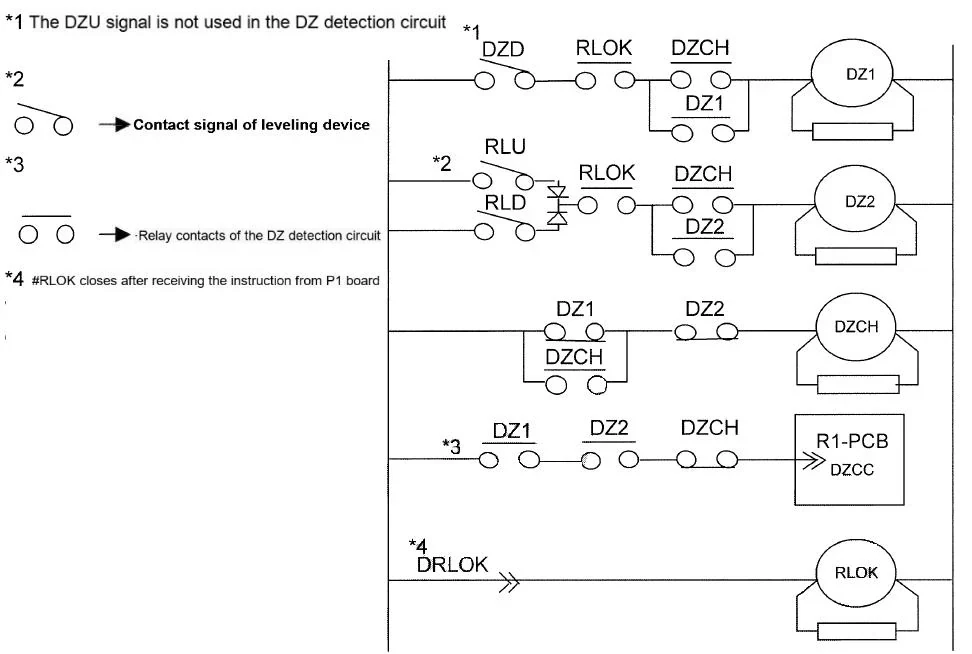
Door Zone Safety Check:
-
Parallel to door locks. Activates only when doors are open in the landing zone.
-
Critical Functions:
-
Cuts power to #5 (main contactor) and #LB (brake contactor) if triggered.
-
Monitored via LEDs on P1 board (#29, #41DG, #89).
4.2 General Troubleshooting Steps
4.2.1 Fault Identification
Symptoms:
-
#29/#89 LED off → Safety chain interrupted.
-
Emergency stop → Safety circuit triggered during operation.
-
No startup → Safety circuit open at rest.
Diagnostic Methods:
-
LED Indicators:
-
Check P1 board LEDs (#29, #41DG) for open circuits.
-
-
Fault Codes:
-
E.g., "E10" for safety chain interruption (for transient faults).
-
4.2.2 Fault Localization
-
Stable Open Circuit:
-
Use zone-based testing: Measure voltage at junction points (e.g., pit, machine room).
-
Example: If voltage drops between junction J10-J11, inspect switches in that zone.
-
-
Intermittent Open Circuit:
-
Replace suspicious switches (e.g., worn pit switch).
-
Bypass test: Use spare wires to redundantly connect cable segments (exclude switches).
-
WARNING: Never short-circuit safety switches for testing.
4.2.3 Door Zone Safety Faults
Symptoms:
-
Sudden stops during re-leveling.
-
Fault codes related to door zone signals (RLU/RLD).
Root Causes:
-
Misaligned Door Zone Sensors (PAD):
-
Adjust gap between PAD and magnetic vane (typically 5–10mm).
-
-
Faulty Relays:
-
Test relays (DZ1, DZ2, RZDO) on protection boards.
-
-
Signal Wiring Issues:
-
Check for broken/shielded wires near motors or high-voltage cables.
-
4.3 Common Faults & Solutions
4.3.1 #29 LED Off (Safety Chain Open)
| Cause | Solution |
|---|---|
| Open Safety Switch | Test switches sequentially (e.g., governor, pit switch, emergency stop). |
| 00S2/00S4 Signal Loss | Verify connections to 400 signal (for specific models). |
| Faulty Safety Board | Replace W1/R1/P1 board or landing inspection panel PCB. |
4.3.2 #41DG LED Off (Door Lock Open)
| Cause | Solution |
|---|---|
| Faulty Door Lock | Inspect car/landing door locks with multimeter (continuity test). |
| Misaligned Door Knife | Adjust door knife-to-roller gap (2–5mm). |
4.3.3 Emergency Stop + Button Lights On
| Cause | Solution |
|---|---|
| Door Lock Interruption | Check for door lock disengagement during run (e.g., roller wear). |
4.3.4 Emergency Stop + Button Lights Off
| Cause | Solution |
|---|---|
| Safety Chain Triggered | Inspect pit switches for corrosion/cable impact; test overspeed governor. |
5. Diagrams
Figure 4-1: Safety Circuit Schematic
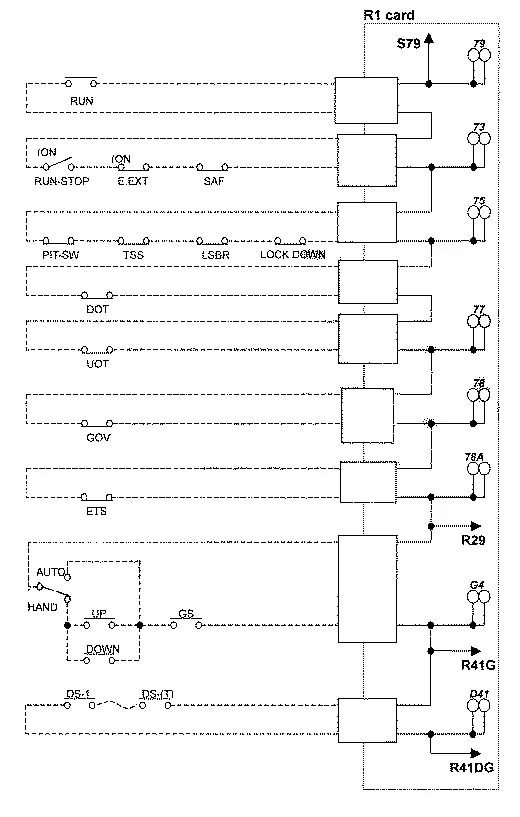
Figure 4-2: Door Zone Safety Circuit
Document Notes:
This guide aligns with Mitsubishi elevator standards. Always deactivate power before testing and consult model-specific manuals.
© Elevator Maintenance Technical Documentation